Thursday, 08 October 2026
New AAHMS Fellows elected for 2026
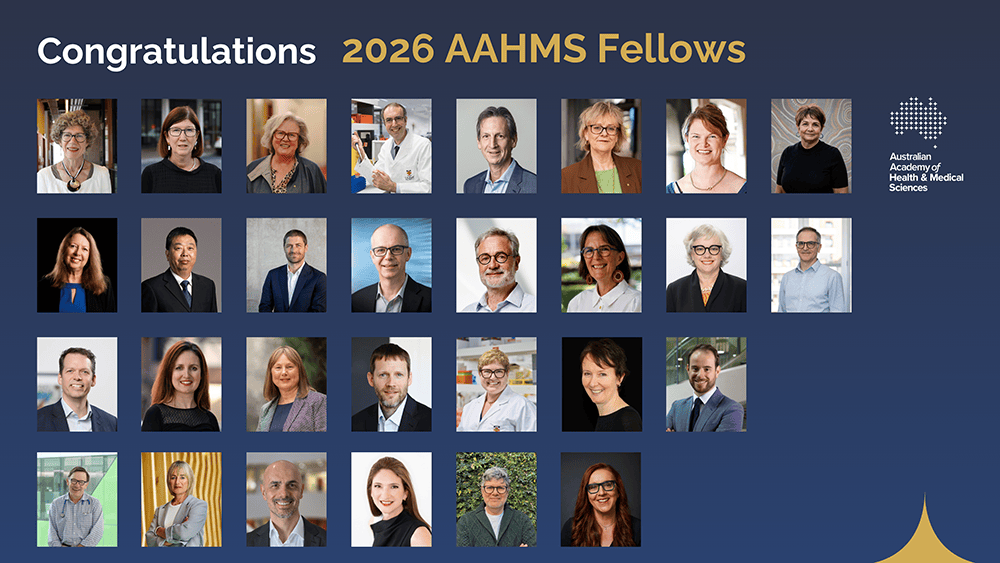
29 leading health and medical researchers elected as Fellows of the Australian Academy of Health and Medical Sciences
The Australian Academy of Health and Medical Sciences (AAHMS) has announced the election of 29 new Fellows for 2026, recognising outstanding contributions to health and medical science across research, clinical practice, public health, innovation and leadership.
Election to the Academy is one of the highest honours in Australian health and medical sciences. Fellows are elected by their peers for their exceptional achievements and sustained contributions to improving health and advancing health and medical science in Australia.
The 2026 cohort spans a remarkable breadth of expertise, from cancer genomics, infectious diseases and precision medicine to injury prevention, mental health, immunisation, Indigenous health and the social and behavioural dimensions of health.
Academy President Professor Louise Baur AM PresAHMS said the new Fellows reflect both the strength and breadth of Australia’s health and medical sciences.
“Our new Fellows have each made an exceptional contribution to improving health – whether through scientific discovery, clinical care, public health and prevention, new technologies, or by translating evidence into policy and practice,” Professor Baur said.
“What unites them is not only excellence in their respective fields, but a commitment to using their expertise to make a difference to people’s lives.
“Many have spent decades building the evidence, services, technologies and approaches that now shape how we prevent disease, deliver care and improve health. Their election recognises both the significance of what they have achieved and the contribution they continue to make.
“The Academy relies on the breadth and depth of expertise within our Fellowship to provide independent advice on the health challenges facing Australia today, and to help us anticipate and prepare for those that lie ahead. We are very pleased to welcome this outstanding group to the Fellowship.”
Among the 2026 Fellows is Professor Julie Leask AO, a world-leading social scientist whose research has transformed understanding of the social and behavioural dimensions of immunisation.
For more than two decades, Professor Leask has worked at the intersection of research, policy and public communication to understand why people accept, delay or decline vaccination, and how health professionals and governments can respond effectively. Her work has been particularly influential in shifting approaches to vaccine hesitancy away from simply providing more information and towards understanding the complex social, behavioural and practical factors that shape vaccination decisions.
Her expertise has informed the work of the World Health Organization, UNICEF and other major international health bodies, and has helped shape how governments and health professionals communicate about immunisation and build public confidence in vaccination. Her election comes a time when maintaining trust in health advice and improving vaccination coverage remain important challenges for Australia and health systems internationally.
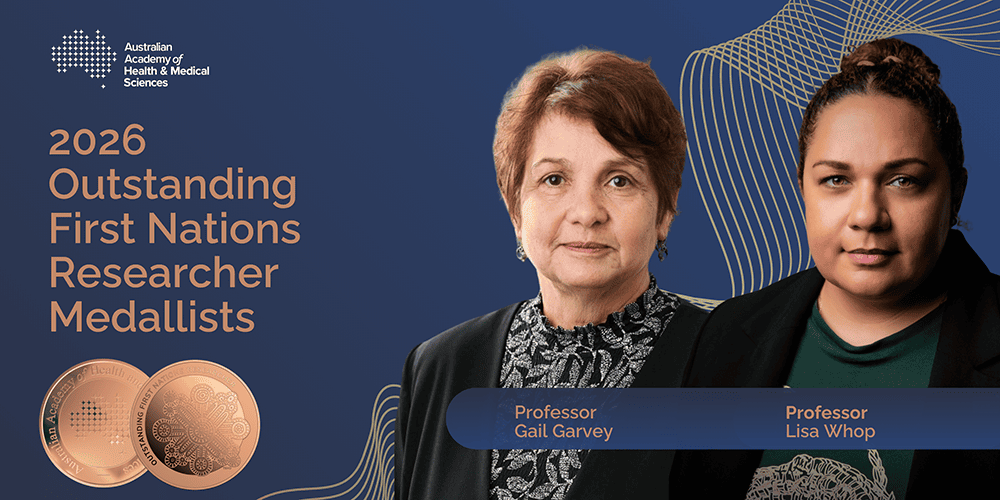
Professor Gail Garvey AM is recognised for her pioneering work to improve cancer outcomes and wellbeing for Aboriginal and Torres Strait Islander peoples.
Professor Garvey has built an internationally recognised program of research focused on understanding and addressing disparities in cancer outcomes for Indigenous peoples. Her work has helped bring greater national attention to inequities in cancer prevention, diagnosis, treatment and survivorship, while building the evidence needed to improve care.
Her research has shaped national policy, clinical guidelines and screening programs, including the development of culturally appropriate measures of wellbeing now embedded in cancer services. Internationally, she founded the World Indigenous Cancer Conference and has helped build global networks bringing together Indigenous communities, researchers, clinicians and policymakers to improve cancer outcomes for Indigenous peoples.
Also elected is Professor David Thomas, a leading clinician-scientist in precision oncology whose work is harnessing genomics to improve cancer diagnosis and treatment, particularly for people with rare cancers and sarcomas.
Professor Thomas has made major contributions to understanding inherited cancer risk and translating genomic discoveries into better approaches to prevention, diagnosis and treatment. His work has included developing new approaches to screening for hereditary cancer syndromes and leading international clinical trials designed to bring precision medicine to patients who have historically had limited treatment options.
Professor Baur said the diversity of expertise represented across the 2026 cohort was central to the strength of the Academy.
“Health and medical science is increasingly interconnected. Addressing our most complex health challenges requires expertise that reaches from fundamental discovery and clinical practice through to public health, prevention, social science, technology and policy.
“No single discipline can answer these challenges alone. One of the great strengths of the Academy is our ability to bring together leaders from across the health and medical sciences and draw on their collective expertise to address issues of national importance.
“Our new Fellows add to that breadth of knowledge in the Academy. They join a Fellowship that has an important responsibility not only to recognise excellence, but to put that expertise to work for the benefit of the Australian community.
“We look forward to the contribution our new Fellows will make to the Academy, to their respective fields, and to the future of health and medical science in Australia.”
The new Fellows will be formally inducted at the Academy’s 2026 Annual Meeting, Scanning Horizons, on 22 October – they will join a Fellowship of more than 550 of Australia’s leading health and medical scientists, clinicians and health leaders.
From 22 October 2026, AAHMS New Fellows:
Professor Jacqueline Center FAHMS, St Vincent’s Hospital
Conjoint Professor Jacqueline Close AM FAHMS, Prince of Wales Hospital
Professor Kay Crossley AM FAHMS, La Trobe University
Professor Merlin Crossley AM FAHMS, UNSW Sydney
Professor Nigel Curtis FAHMS, The University of Melbourne
Professor Caroline Finch AO FAHMS, Edith Cowan University
Professor Josephine Forbes FAHMS, Mater Research
Professor Gail Garvey AM FAHMS, The University of Queensland
Distinguished Professor Lynette Griffiths AM FAHMS, Queensland University of Technology
Professor YuanTong Gu FAHMS, Queensland University of Technology
Professor Marco Herold FAHMS, Olivia Newton-John Cancer Research Institute
Professor Mark Jenkins FAHMS, The University of Melbourne
Professor Tomas Kron OAM FAHMS, Peter MacCallum Cancer Centre
Professor Amanda Leach AM FAHMS, Menzies School of Health Research
Professor Julie-Anne Leask AO FAHMS, The University of Sydney
Professor Guillaume Lessene FTSE FAHMS, The Walter and Eliza Hall Institute of Medical Research
Conjoint Professor Daniel MacArthur FAHMS, Garvan Institute of Medical Research
Professor Carol Maher FAHMS, Adelaide University
Distinguished Professor Meg Morris FAHMS, La Trobe University
Professor Kevin Pfleger FAHMS, The University of Western Australia
Professor Phoebe Phillips AM FAHMS, UNSW Sydney
Professor Jane Pirkis FAHMS, The University of Melbourne
Professor Joseph Powell FAHMS, Garvan Institute of Medical Research
Professor Peter Richmond FAHMS, The University of Western Australia
Professor Jo Robinson AM FAHMS, Orygen
Professor Emmanuel Stamatakis FAHMS, Monash University
Professor Fiona Stapleton AO FTSE FAHMS, UNSW Sydney
Professor David Thomas FAHMS, UNSW Sydney
Professor Carla Treloar AM FASSA FAHMS, UNSW Sydney
For media enquiries, please contact Khaled Chakli: 0423 099 568
AAHMS
Related Publications