Thursday, 22 October 2026
2026 Annual Meeting – President’s opening address
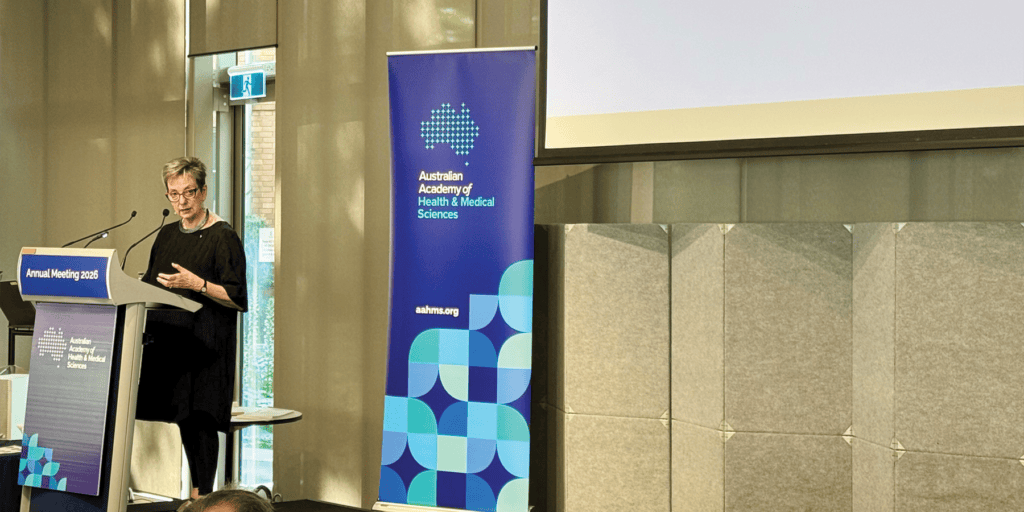
Good morning, everyone, Fellows, colleagues and guests, and welcome.
I begin by acknowledging the Gadigal people – the people of the grass tree – of the Eora Nation, the Traditional Custodians of the land on which we gather, and pay my respects to Elders past and present. I extend that respect to Aboriginal and Torres Strait Islander people joining us today.
It is a pleasure to welcome you to Sydney for the Australian Academy of Health and Medical Sciences’ 2026 Annual Scientific Meeting.
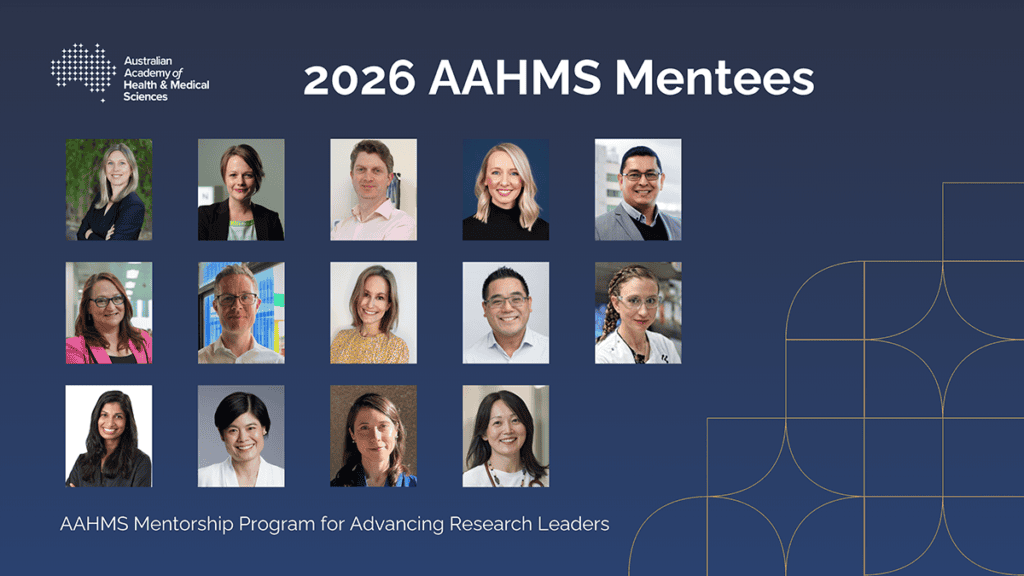
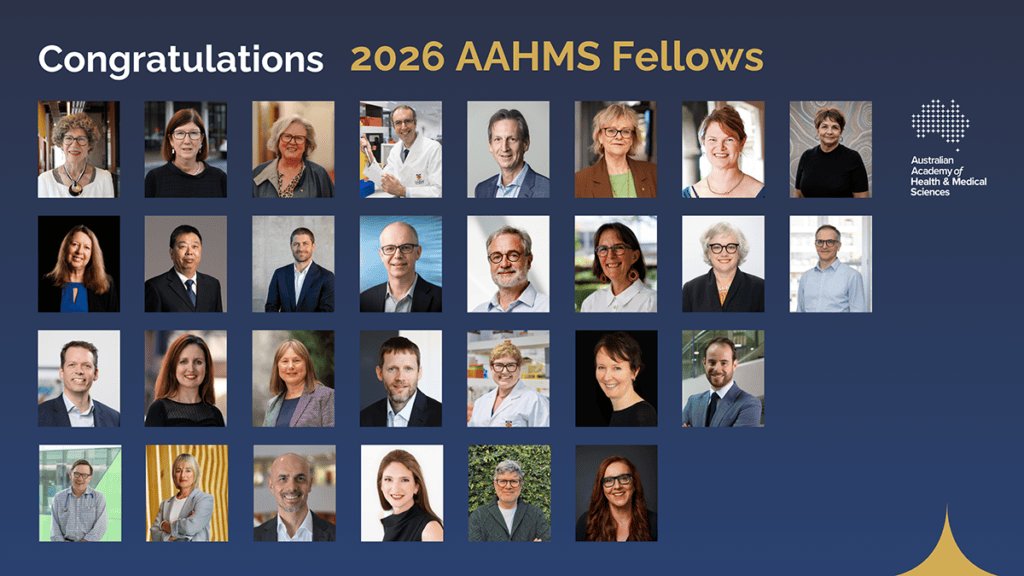
A particularly warm welcome to our newest Fellows. Your election recognises the distinction of your work and its contribution to better health. Today, we celebrate those achievements and the perspectives you bring to our shared endeavour.
The Academy brings together exceptional people around a common purpose to put knowledge and expertise to work for the public good.
Our new Strategic Plan carries that purpose forward through four pillars
- translating evidence into policy and practice
- building national capability
- championing health in our region; and
- recognising and harnessing excellence
Across each runs a commitment to independent advice, First Nations health and wellbeing, stronger connections between academia, healthcare and industry, and diversity, equity and inclusion.
These commitments shape both the questions we ask and the people we bring together to answer them.
And they lead naturally to the theme of this year’s meeting: Scanning Horizons.
As researchers, clinicians and leaders, much of our attention is necessarily directed towards the immediate. The experiment that needs completing. The patient who needs care … nowadays…the service under pressure … and the decision that cannot wait.
Yet, we also have a responsibility, to consider what is coming, and what we should be doing now to prepare.
Scientific advances are opening up possibilities that would once have seemed extraordinary. Artificial intelligence is changing how we generate and use knowledge. New therapies are challenging established approaches to treatment.An example in my own field of is the impact of GLP1 receptor agonists and similar medications on obesity management. At the same time, changing patterns of disease, environmental pressures and demographic shifts are creating new demands on our research and health systems.
How we respond will depend, in part, on how early we understand their significance.
Horizon scanning gives us a way to examine those developments systematically, connect insights across disciplines and consider their implications before our choices narrow.
It asks us to look beyond what is already prominent, towards emerging ideas, early signals and changes that may be difficult to interpret.
That requires curiosity. It also requires judgement.
Some developments will prove less consequential than anticipated. Others may transform an entire field. We need to assess the evidence carefully, remain honest about uncertainty and be willing to revisit our assumptions.
Crucially, we must consider how developments interact.
A promising therapy raises questions about clinical benefit, but also manufacturing, workforce, infrastructure and access. A new technology may change what is possible in care, while creating new expectations about privacy, fairness and accountability.
Understanding those connections is essential if scientific progress is to translate into public benefit.
That is why this conversation belongs here.
Across our Fellowship, and among our speakers and guests, we have people who see different parts of the emerging picture. Bringing those perspectives together can reveal possibilities and implications that any one discipline or institution might miss.
The National Health and Medical Research Strategy gives Australia an important opportunity to strengthen that collective capability.
As its implementation progresses, we should ask how horizon scanning can inform the decisions that determine our readiness … where we invest, which skills we develop, what infrastructure we build and how we prepare our health services.
The value of foresight is realised when it changes what we do.
Our outlook must also extend beyond Australia. The Academy’s growing Asia-Pacific ambition recognises how much we can achieve through regional partnership, shared knowledge and learning from different experiences.
The challenges ahead cross borders. So do the opportunities to respond.
Throughout this meeting, I encourage you to bring your own perspective generously, and to seek out those who challenge it.
What are we seeing early that others need to understand?
Which assumptions about the future deserve closer examination?
And what decisions could we make today that would leave Australia better prepared five, ten or twenty years from now?
I thank our speakers, panellists and everyone who has helped bring this program together.
Let us use this meeting to broaden our view, make new connections and turn our collective understanding towards the choices ahead.
Thank you, and welcome to the 2026 Annual Scientific Meeting of the Australian Academy of Health and Medical Sciences.
AAHMS
Related Publications
Australia is glimpsing health and medical horizon in fragments, Academy warns