Friday, 23 October 2026
Academy sets out priorities for strengthening trust in health and medical expertise
Australians’ trust in health and medical science remains strong, but it is unevenly held and cannot be taken for granted, according to a Communiqué from the Australian Academy of Health and Medical Sciences.
The Communiqué draws on a recent Academy roundtable that brought together national and international experts from medical research, healthcare, public health, social science and policy. It is the latest output of the Academy’s Trust Project, a multi-year initiative to understand, measure and strengthen trust in health and medical expertise.
Healthcare is Australia’s most trusted sector and scientists its most trusted group of people, according to the 2025 Edelman Trust Barometer. However, as the Communiqué warns, headline figures can mask important gaps, and trust tends to be thinnest among communities who have been excluded from, or poorly served by, health and medical research and the health system it enables.
In addition, high trust also does not always translate into action. Data from the National Vaccination Insights Project show that the proportion of Australian parents who did not trust vaccine information from a doctor or nurse rose from 6.4% in 2024 to 8.8% in 2025. Among parents of unvaccinated children, more than four in ten cited a lack of trust in that information.
“Trust in expertise can be strengthened or weakened at many points in the health and medical science system: from how research is designed, undertaken and peer reviewed, through to how findings are communicated and translated into policy,” said Academy President, Professor Louise Baur AM PresAHMS.
“Ultimately, it comes down to people’s interactions with health professionals and their experience of the health system.”
The Academy’s recent roundtable identified four priorities for the sector:
- Strengthening research integrity and professional standards;
- Building trusted relationships between researchers, health professionals, communities and policymakers;
- Communicating evidence and uncertainty openly;
- Engaging with the information environments where people form health judgements, from social media and search engines to AI assistants and community networks.
“Trust in health and medical science can only be strengthened through a sustained and simultaneous fine-tuning of each part of this system,” said Professor Baur. “This is why the Academy’s Trust Project brings together scientists and researchers, policymakers and health leaders.”
The Communiqué builds on the Academy’s earlier Trust Project outputs: Understanding Trust in the Health and Medical Sciences (2025), which mapped the dimensions of trust; evidence brief Measuring Trust in Health and Medical Science (2026), which synthesised opinion and behavioural data on the state of Australians’ trust; and its 2025 Annual Meeting, Trust in health and medicine, which was held in Old Parliament House, Canberra. A forthcoming Academy evidence brief will examine trends in childhood vaccination in depth.
“Trust is something the health and medical science sector must work to continually earn from Australian communities,” said Professor Baur. “The Academy will continue to bring together the nation’s leading expertise to understand what strengthens trust, where it is at risk, and how the system can respond.”
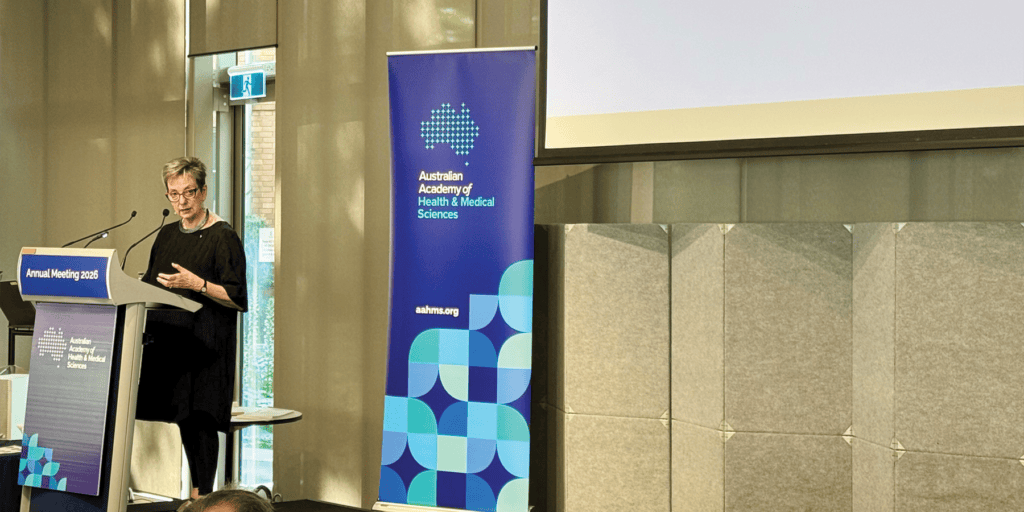
Trust will also be a focus of the Academy’s 2026 Annual Meeting in Sydney. On Friday 23 October, a panel session, Trust in Health and Medicine: Where Are We Now?, will revisit the theme of the Academy’s 2025 meeting and consider the emerging pressures likely to shape trust over the next decade.
The Academy’s Communiqué is available here.
All of the Academy’s Trust Project outputs are available here.
AAHMS
Related Publications
Australia is glimpsing health and medical horizon in fragments, Academy warns