Thursday, 30 October 2025
President’s Address: 2025 Academy Annual Gala Dinner
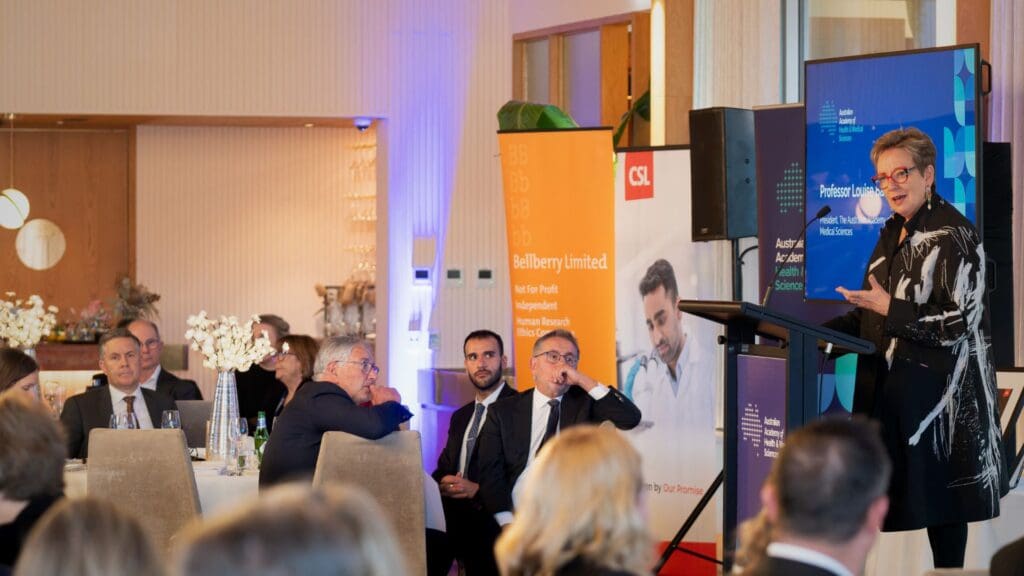
Good evening, colleagues, Fellows, and esteemed guests.
I’d like to begin firstly by acknowledging the traditional custodians of the lands on which we are gathered tonight, the lands of the Ngunnawal and Ngambri peoples — and to pay my respects to their Elders past and present, and extend that respect to any Aboriginal and Torres Strait Islander people joining us today.
I’d also like to acknowledge and welcome, Minister the Honourable, Mark Butler MP, Minister for Health and Ageing, and The Honourable Rebecca White MP, Assistant Minister for Health and Aged Care, for Indigenous Health, and for Women.
I’m delighted to address you at the end of this, my second year, as President of the Australian Academy of Health and Medical Sciences.
Although the Academy has many functions and accomplishments, it was established to serve a single, enduring purpose: to bring the nation’s best minds together in service of the public good.
We were not created to sit in an ivory tower, we were built to be a bridge. A bridge between science and society, between research and real-world practice, and, between evidence and the decisions that shape our future.
Our Fellows are elected for their outstanding achievements, but collectively we exist for something larger than any individual.
The Academy of Health and Medical Sciences exists to serve as a trusted advisor to government, to health leaders, and to the Australian community; offering independent, expert, evidence-based advice on the issues that shape the nation’s health.
In a time when the world is awash with information – but hungry for truth – that role has never been more vital.
That is why this year’s Annual Meeting centres on Trust in Health and Medical Science.
Trust is not a slogan.
It is the currency of the social contract between science and society, and in health, that contract is sacred.
In Australia, the delivery of universal, evidence-based healthcare is not just a policy choice; it is a national institution, and part of who we are.
When trust in that system falters, the consequences reach far beyond the clinic. A weakening of trust in health and medical science can lead to a weakening of social cohesion, and if uncorrected, ultimately, to a weakening of democracy itself.
The data are sobering.
The 2025 Edelman Trust Barometer shows that more than half of people globally believe government and business leaders purposely mislead the public on health matters, and that no major institution, government, business, NGO, or media, is trusted to meet people’s health needs.
Even more striking: one in three young people now say they are uncertain about routine childhood vaccines, but at the same time many have made health decisions they regret because of misinformation.
In today’s world, trust is rooted in the familiar.
It’s placed in families and neighbourhoods.
It’s also placed in doctors’ rooms and in local services – where care is personal and relationships have been built over time.
More than ever, people are placing their trust in their peers – and in their communities, which are increasingly moving online – far more than the institutions that traditionally underpin health systems and science.
This decentralisation of trust poses a profound challenge. The diffusion of trust across so many voices makes it harder for evidence to rise above the noise.
If expertise loses its legitimacy, and institutions lose their credibility, what fills the vacuum?
Too often, it is ideology, populism, and fear.
We cannot allow that to become the defining story of health and medicine in Australia.
Our response must be to strengthen trust; to maintain trust where it exists; to rebuild trust where it has been lost …. patiently, transparently, and by meeting people where they are.
Trust is earned not only through data, but through dialogue.
Not only through evidence, but through empathy.
That is why the National Health and Medical Research Strategy represents such a landmark opportunity.
It is the first time in our history that Australia will have a unified, national vision for health and medical research. A vision that aligns investment, priorities, and impact across the system.
If implemented boldly, the Strategy can help rebuild trust in health and medical science by embedding that science and research directly into the systems that serve the public.
In our submissions to government, the Academy has made clear that trust is strengthened when research is not an afterthought, but a function of care itself.
Research-active health systems deliver better outcomes, attract and retain skilled staff, and – crucially in the context of trust – increase patients’ confidence in their care.
When patients see research happening around them, they see progress.
And when they see progress, they see purpose.
We have also urged government to ensure that horizon scanning – the ability to look beyond the immediate, to anticipate risks and opportunities before they arrive – sits at the heart of the national approach.
It’s not enough to look toward the horizon; Australia must look over it.
That means scanning not only for threats – pandemics, climate shocks, or data risks – but for emerging opportunities: AI in diagnostics, next-generation vaccines, gene and cell therapies, and models of care that we can scarcely imagine today.
Horizon scanning must not be a passive exercise.
It must drive real-world decisions – in funding, regulation, and policy.
It is here, that the Academy – comprised of the nation’s leading minds – stands ready to serve.
Our Fellows represent the depth and breadth of expertise needed to interpret weak signals, validate insights, and turn foresight into actionable advice.
We are ready to help ensure that this part of the Strategy becomes not a report on a shelf, but a living, national capability – one that builds trust by anticipating the future rather than reacting to it.
The task ahead is not small.
Building trust in health and medical science will require all of us – scientists, clinicians, policymakers, communicators – to act with humility as well as authority.
To listen as much as we lead.
And to remember that trust is not granted; it is earned.
If we succeed, we will not only strengthen the foundations of our health system –
we will strengthen the very fabric of our democracy.
Thank you.
AAHMS
Related Publications