Monday, 14 September 2026
2026 Outstanding First Nations Researcher Medals
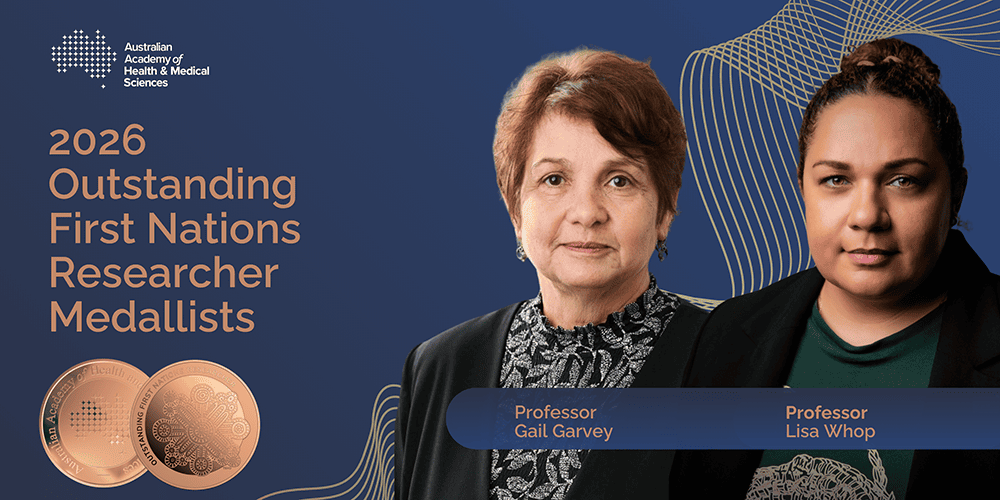
Professor Gail Garvey and Professor Lisa Whop awarded 2026 Outstanding First Nations Researcher Medals
The Australian Academy of Health and Medical Sciences has awarded the 2026 Outstanding First Nations Researcher Medal to two exceptional Indigenous researchers whose work is advancing cancer prevention, care and health equity: Professor Gail Garvey AM and Professor Lisa Whop.
Professor Garvey has been recognised for her leadership in improving cancer outcomes for Aboriginal and Torres Strait Islander peoples across the cancer continuum. Professor Whop has been recognised for her Indigenous-led research transforming cervical and lung cancer screening.
Their work demonstrates the importance of placing Aboriginal and Torres Strait Islander knowledge, leadership and community priorities at the centre of health and medical research.
Professor Gail Garvey AM, for transforming cancer care for Aboriginal and Torres Strait Islander peoples.
Professor Garvey, a proud Kamilaroi woman, is an NHMRC Research Leadership Fellow and Professor of Indigenous Health Research at The University of Queensland.
Her research focuses on improving outcomes for Aboriginal and Torres Strait Islander peoples throughout the cancer journey – from prevention and screening to diagnosis, treatment and survivorship. This includes strengthening health service and building the cultural capability of the cancer workforce so that care is more accessible equitable and culturally safe.
“I am deeply honoured and humbled to receive the Australian Academy of Health and Medical Sciences Outstanding First Nations Researcher Medal,” Professor Garvey said.
“This recognition is particularly meaningful because it acknowledges not only my work, but also the collective efforts of the many First Nations peoples, communities, clinicians, partner organisations and the team I lead who have walked alongside me throughout my career.”
Professor Garvey was drawn to cancer research by the profound disparities experienced by Aboriginal and Torres Strait Islander peoples, as well as her own family’s experiences of cancer. When she began her career, there was very little First Nations research or leadership in the field.
Her team has helped establish the evidence showing where cancer inequities occur and how health systems can respond more effectively. This research has helped shape national priorities, policies and Optimal Care Pathways for culturally safe cancer care.
The team has also developed culturally appropriate patient-reported measures, including a supportive care needs assessment tool and a wellbeing measure now recommended in Australia’s Optimal Care Pathways. These tools ensure that the experiences, priorities and outcomes that matter to Aboriginal and Torres Strait Islander people are captured and used to improve the quality, safety and responsiveness of care.
Translation into practice has been central to Professor Garvey’s work. Research conducted in partnership with Aboriginal Community Controlled Health Organisations tested an alternative way of delivering the National Bowel Cancer Screening Program. The findings helped inform a national pathway that now allows eligible Australians to access bowel cancer screening through their GP, supporting increased participation and earlier detection.
For Professor Garvey, the Medal also carries deep personal significance.
“I am the first person in my family to attend university and a second-generation member of the Stolen Generations,” she said.
“Receiving this award reflects not only my own journey, but also the resilience and strength of my family and the opportunities created by those who came before me. It reminds me that barriers can be overcome and that our experiences can help create positive change for future generations of First Nations researchers.”
She acknowledged the Aboriginal and Torres Strait Islander communities, Elders, patients and families who have entrusted her team with their stories and partnered in its research, as well as well as her colleagues, collaborators, clinicians, students and mentors.
“Science is fundamentally collaborative, and the strongest research comes from bringing together diverse expertise while respecting different ways of knowing,” Professor Garvey said.
Her advice to emerging researchers is to remain connected to their purpose and recognise the strength of their lived experience, culture and community knowledge.
“Most importantly, remember that your success creates opportunities for those who follow,” she said. “By supporting one another and lifting others as we progress, we strengthen the future of First Nations research.”
Professor Garvey is now focused on addressing the continuing disparities that contribute to later cancer diagnoses, barriers to treatment and culturally unsafe care. She is also encouraged by the growing strength of the Aboriginal and Torres Strait Islander research workforce.
“More Aboriginal and Torres Strait Islander researchers are leading research, shaping priorities and bringing Indigenous knowledge, culture and lived experience into science,” she said.
“This is critical to developing culturally relevant solutions that translate into better cancer care and outcomes, while inspiring the next generation of First Nations researchers.”
Professor Lisa Whop, for advancing equitable cancer screening through Indigenous-led research.
Professor Whop is a Wagadagam Gumulgal woman and Indigenist epidemiologist at Yardhura Walani, the National Centre for Aboriginal and Torres Strait Islander Wellbeing Research at The Australian National University.
Her research focuses on cancer prevention and screening for Aboriginal and Torres Strait Islander peoples, particularly cervical cancer and, increasingly, lung cancer.
“I feel incredibly honoured and humbled to receive this recognition,” Professor Whop said.
“As a Wagadagam Gumulgal woman and epidemiologist, it is particularly meaningful to see Aboriginal and Torres Strait Islander-led research recognised within Australia’s health and medical sciences.”
Cervical cancer is almost entirely preventable, yet Aboriginal and Torres Strait Islander women continue to experience a substantially greater burden of the disease. This inequity has driven much of Professor Whop’s research.
Rather than asking why women do not participate in screening, her work examines the health systems, policies and programs that can make screening difficult to access or culturally unsafe – and how those systems can be changed.
“Epidemiology gives us powerful tools, but tells us only one part of the story,” she said. Her research therefore works across disciplines to understand the experiences behind the numbers and identify practical ways to achieve change.
A major contribution from Professor Whop and her collaborators has been demonstrating what becomes possible when women have more choice and control over cervical screening.
Her research found that self-collection for human papillomavirus testing was highly acceptable to Aboriginal and Torres Strait Islander women, offering greater privacy, comfort, convenience and control. This evidence has contributed to national policy and practice, supporting universal access to self-collection through the National Cervical Screening Program.
More recent modelling by her team found that, without further action, cervical cancer elimination for Aboriginal and Torres Strait Islander woman would occur much later than for the wider Australian population. Crucially, the research also showed that this disparity is not inevitable. Reaching women who have never participated in screening and ensuring appropriate follow up could bring elimination forward substantially.
“Australia may be on track to become one of the first countries in the world to eliminate cervical cancer, but we cannot call that a public health success if Aboriginal and Torres Strait Islander women and people are left behind,” Professor Whop said.
Her team is working with Aboriginal Community Controlled Health Organisations and rural and remote communities to translate these advances into practice. This includes community-designed approaches to self-collection, point-of-care HPV testing and models that shorten the pathway from screening to diagnosis and treatment.
The same approach underpins the Sestaman study, which is evaluating Australia’s National Lung Cancer Screening Program from an Indigenous perspective. The study is examining who the program reaches, people’s experiences of screening, barriers encountered by services, cultural safety and whether the program delivers equitable outcomes.
“Ultimately, I want our research to make it easier for people to receive prevention and care that is effective, culturally safe and designed around their needs,” Professor Whop said.
She credited the Aboriginal and Torres Strait Islander women, families and communities who have shared their experiences and knowledge, along with Aboriginal Community Controlled Health Organisations, health workers, practitioners, colleagues and collaborators.
“Everything I have achieved has been collective,” she said. “Mentorship has also taught me that our responsibility is not simply to build our own careers. It is to create opportunities for others.”
Her advice to early career researchers, particularly Aboriginal and Torres Strait Islander researchers, is to hold onto who they are and why they entered research.
“We as Aboriginal and Torres Strait Islander researchers bring knowledge, relationships, perspectives and intellectual traditions, rigour and depth that health and medical research needs,” she said.
“Ask questions that matter to our communities, even when those are not the easiest questions for institutions or systems to answer.”
Looking ahead, Professor Whop wants to use this evidence to to change the systems that produce inequities, not only to expose them. Alongside her work in cervical and lung cancer screening, she will continue building Indigenous-led research capability so that Aboriginal and Torres Strait Islander peoples lead the evidence, set research agendas and shape the systems affecting their health.
About the Outstanding First Nations Researcher Medal
The Australian Academy of Health and Medical Sciences’ Outstanding First Nations Researcher Medal is awarded annually to one or more outstanding mid-career researchers of Aboriginal and/or Torres Strait Islander descent who are emerging as research leaders and making an influential contribution to health and medical science in Australia.
The Medal recognises research across clinical medicine, public health, biomedical and social sciences, and related fields. It also helps recipients expand their research networks and participate in national or international knowledge exchange.
Each recipient receives a $10,000 travel grant alongside the Medal, made possible through the generous support of Bellberry Limited. The grant enables recipients to visit relevant research centres and build collaborations through research-related travel in Australia or overseas. The Academy gratefully acknowledges Bellberry Limited’s support and its contribution to making this valuable opportunity possible.
The 2026 Medals will be formally conferred at the Academy’s Annual Meeting in October.
For media enquiries, please contact Khaled Chakli: 0423 099 568
AAHMS
Related Publications
Academy sets out priorities for strengthening trust in health and medical expertise