Monday, 21 September 2026
2026 Outstanding Female Researcher Medal
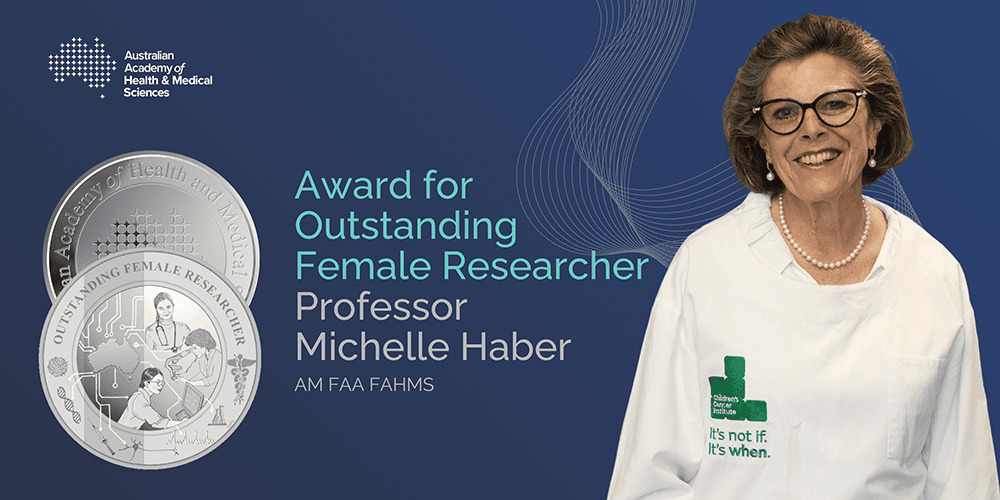
Professor Michelle Haber awarded 2026 Outstanding Female Researcher Medal
The Australian Academy of Health and Medical Sciences has awarded the 2026 Outstanding Female Researcher Medal to Professor Michelle Haber AM FAA FAHMS, recognising more than four decades of research that has transformed the diagnosis and treatment of childhood cancer.
Professor Haber is internationally recognised for developing more effective and less toxic treatments for children with cancer. Her discoveries in molecular diagnostics, targeted therapies and precision medicine have changed standards of care and improved survival for children with some of the most aggressive cancers.
“I feel very proud and honoured to receive this Medal, and to be recognised alongside such an impressive cohort of women whose work has made an outstanding contribution to health and medical sciences,” Professor Haber said.
“I’m also grateful for the opportunity this award provides to highlight the importance of research into childhood cancer, with more children currently dying from cancer in Australia than from any other disease.”
Professor Michelle Haber, for transforming childhood cancer treatment through precision medicine
Professor Haber is a Conjoint Professor at UNSW Sydney and Co-Group Leader of the Experimental Therapeutics and Molecular Oncology Group at Children’s Cancer Institute, where she served as Executive Director from 2003 to 2025.
For more than 40 years, her research has focused on childhood cancer and the development of treatments that target cancer cells while sparing healthy tissue.
“The more I learned about cancer in children, the clearer it became that one of the main problems with treatment was the long-term side effects that could result,” Professor Haber said.
“I wanted to develop new treatment approaches that were not only more effective but also less toxic, by specifically targeting cancer cells in the body and sparing normal tissues.”
In recent years, Professor Haber’s work has increasingly concentrated on precision medicine, using genomic technologies to identify the genetic drivers of each child’s cancer, to then guide their diagnosis and treatment.
Many of her team’s most significant discoveries have involved molecular diagnostics – analysing DNA and RNA from a child’s cancer to understand what is driving its growth and determine how it might best be treated.
Working with Professor Murray Norris and Professor Glenn Marshall, Professor Haber helped develop a minimal residual disease test that enables clinicians to predict early relapse in children with acute lymphoblastic leukaemia, the most common childhood cancer.
During a 10-year clinical trial, use of the test contributed to the survival rate for children with high-risk acute lymphoblastic leukaemia doubling from 35% to 70%. The test is now funded through Medicare.
Professor Haber and her team have also developed new therapies for neuroblastoma, the most common solid tumour in young children. This includes treatment using the drug DFMO, which deprives neuroblastoma cells of cellular components needed to sustain the tumour’s aggressive behaviour. The treatment is now available in Australia for children with high-risk neuroblastoma.
“Seeing our science make a difference, knowing we are giving hope and changing outcomes for kids with cancer, is incredibly rewarding and is what drives me every day,” Professor Haber said.
A new model of care for every Australian child with cancer
Professor Haber considers her proudest achievement to be conceiving, establishing and leading the national rollout of Zero Childhood Cancer, known as ZERO: Australia’s national precision medicine program for children and young people with cancer.
ZERO recognises that every child’s cancer is biologically distinct and that treatment should therefore be tailored to the individual. By analysing each child’s genome and comparing it with the genome of their cancer, the program identifies the molecular changes driving the disease and provides personalised treatment recommendations.
Research from the program has shown that this approach can significantly improve clinical outcomes, including survival. ZERO is now available to every Australian child and young person with cancer and has transformed the model of care for children with high risk disease.
“ZERO has proved to be a trailblazer, representing a whole new way of treating children with cancer,” Professor Haber said.
“It recognises that every child’s cancer is unique and that therefore treatment must be tailored to the individual.”
ZERO is jointly led by Children’s Cancer Institute and the Kids Cancer Centre at Sydney Children’s Hospital. It brings together every children’s hospital in Australia and several research organisations, creating a national partnership between clinicians and scientists.
“We’ve demonstrated the power of doctors and scientists working together, which I believe is the way of the future – not just in the treatment of childhood cancer, but also adult cancer and other diseases,” Professor Haber said.
Collaboration and mentorship across a pioneering career
Professor Haber emphasised that the achievements recognised by the Medal were made possible by decades of collaboration and mentorship.
“Collaboration and mentorship have been fundamental to my success as a researcher – without these, I could only have achieved a fraction of what I’ve been able to achieve,” she said.
The Medal holds particular significance for Professor Haber because it celebrates the contribution of women to research and recognises science that improves people’s health and lives.
Her advice to early-career researchers, particularly women in science, is to pursue work that genuinely motivates them, remain open to new opportunities and seek people who will actively support their development.
“You must love what you do,” Professor Haber said.
“Go where opportunities take you and where you have a passion, be brave and take chances if opportunities come your way. Seek out people who will mentor and support you on your career journey.”
About the Outstanding Female Researcher Medal
The Australian Academy of Health and Medical Sciences’ Outstanding Female Researcher Medal is awarded annually to a leading woman researcher in Australia who has made sustained, exceptional and influential contributions to health and medical research.
The Medal also recognises exceptional leadership and mentorship, as well as an international standing within the health and medical sciences. It forms part of the Academy’s commitment to recognising the achievements of women and advancing diversity and inclusion across the sector.
The Outstanding Female Researcher Medal was made possible by a generous donation from The Gandevia Foundation, for which the Academy is most grateful. The Medal is designed by the Royal Australian Mint.
The 2026 Medal will be formally conferred at the Academy’s Annual Meeting in October.
For media enquiries, please contact Khaled Chakli: 0423 099 568
AAHMS
Related Publications