Thursday, 01 October 2026
2026 Jian Zhou Medal
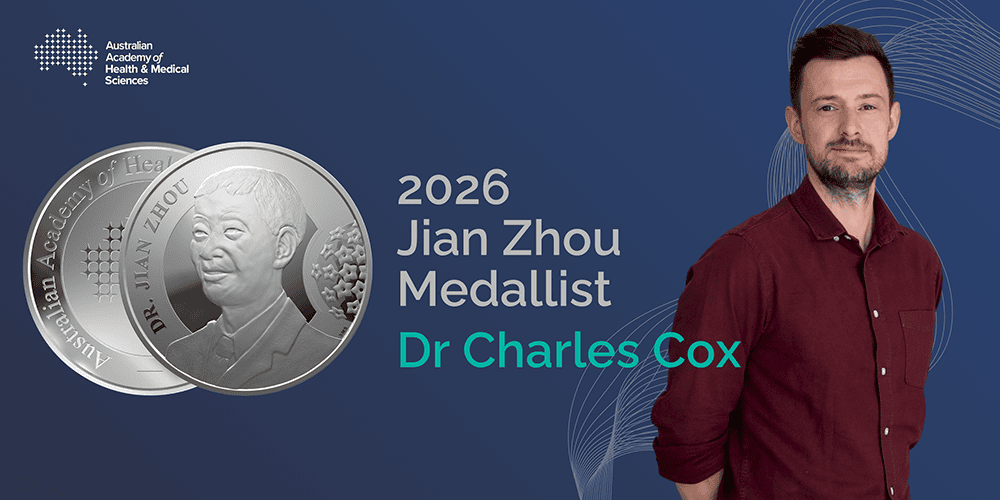
Dr Charles Cox awarded 2026 Jian Zhou Medal
The Australian Academy of Health and Medical Sciences has awarded the 2026 Jian Zhou Medal to Dr Charles Cox, recognising his pioneering research into how cells sense physical forces and the potential to translate these discoveries into new treatments.
Dr Cox leads the Cardiac Mechanobiology Laboratory at the Victor Chang Cardiac Research Institute and is a Senior Research Fellow at UNSW Sydney. His work is establishing mechanobiology and mechanosensitive ion channels as important areas of disease research and therapeutic development.
“It’s a tremendous honour,” Dr Cox said. “I’m deeply grateful to Academy of Health and Medical Sciences for recognising our work, and I see the Jian Zhou Medal as recognition not just of an individual, but of a whole team effort.”
The Medal recognises rising leaders whose research is making a significant impact in translational medical science. It honours the legacy of Dr Jian Zhou, whose work with Professor Ian Frazer and Dr Xiao Yi Sun created the technology underpinning vaccines that protect against human papillomavirus and cervical cancer.
Dr Charles Cox, for unlocking how cells sense force to create new therapeutic possibilities
Dr Cox’s research sits at the intersection of mechanics, cell biology and medicine. His team studies how cells detect physical forces – such as stretching, pressure and changes in their surroundings – and convert them into biochemical signals that influence the function of tissues and organs.
This process, known as mechanosensation, is partly controlled by specialised proteins called mechanosensitive ion channels. Dr Cox’s research focuses particularly on PIEZO1 and PIEZO2, channels that respond to mechanical force and play important roles across many biological systems.
“I truly believe that mechanical forces are a fundamental biological signal, and appreciating that opens new therapeutic opportunities,” Dr Cox said.
“Force is universal in biology, and probably most excitingly, we’re still only beginning to understand the molecular machinery that senses it,” Dr Cox said.
“That creates the rare combination of deep discovery science and clear translational promise.”
A major contribution from Dr Cox and his team has been identifying new mechanisms that regulate PIEZO channels and demonstrating how this regulation affects the behaviour of cells and tissues.
The researchers have also developed ways to investigate mechanosensation with greater precision, connecting detailed biophysical measurements with their functional consequences in relevant biological models.
These advances are helping turn a complex problem involving physical forces into defined molecular targets that can be studied and potentially manipulated.
“It reinforces that taking on hard, mechanism-driven questions can lead to outcomes with genuine impact,” Dr Cox said.
“For the field, it’s encouraging to see mechanobiology and mechanosensitive ion channels recognised as central to understanding disease, not a niche topic.”
From understanding mechanical forces to developing new medicines
Mechanosensitive ion channels influence biological pathways implicated in a wide range of diseases where abnormal mechanical signalling plays a role.
Dr Cox is working to translate knowledge about mechanosensation into compounds that can alter the activity of PIEZO channels. This includes intellectual property arising from the team’s research, creating a potential pathway towards first-in-class therapies.
The goal is to develop treatments that can precisely increase or decrease the activity of mechanosensitive channels, depending on their role in a particular disease.
Even before prospective therapies reach clinical trials, the processes used to develop and refine these may inform research aimed at enabling more effective evaluation of potential drug targets, identifying patients most likely to benefit, and measuring whether a treatment is having its intended biological effect.
Dr Cox said two substantial challenges remain: convincingly connecting molecular mechanosensation to the function of entire organs, and converting knowledge of mechanosensitive channels into safe and effective disease-specific treatments.
“These proteins are powerful, so specificity and context really matter,” he said.
His next phase of research will focus on connecting mechanism to intervention, including developing potential treatments in areas such as obesity.
Dr Cox is also interested in solving some of the field’s outstanding biological mysteries. These include identifying the currently unknown ion channels that may be responsible for some forms of mechanical pain and developing tools that allow mechanosensation to be measured and manipulated within living systems.
“I’m very excited to help identify these mystery molecules and build the tools needed to measure and manipulate mechanosensation in vivo, with clear biomarkers and translational endpoints,” he said.
A multidisciplinary team effort
Dr Cox emphasised that the Medal reflects the collective work of his students, postdoctoral researchers, collaborators and mentors, supported by the research environment at the Victor Chang Cardiac Research Institute.
“This medal reflects an enormous collective effort,” he said.
Collaboration is especially important in mechanobiology because research questions in the field span multiple disciplines, from physics and engineering to cell biology, physiology and medicine.
“When it works well, the whole becomes far more than the sum of the parts,” Dr Cox said.
His advice to early-career researchers is to choose a problem that genuinely inspires their curiosity and build a research strategy around focus and rigour.
He encourages emerging researchers to develop a clear research identity, establish strong relationships with collaborators and mentors, and protect the uninterrupted time needed to think deeply about their science.
“In a world full of distractions, your most valuable resource is sustained attention, so guard your time and keep the science at the centre,” Dr Cox said.
“Finally, stay as close as possible to the data, and be willing to change your mind when the evidence points you in a new or unexpected direction.”
About the Jian Zhou Medal
The Australian Academy of Health and Medical Sciences’ Jian Zhou Medal is awarded annually to a rising leader in Australian health and medical science who is making a significant impact in translational medical research.
The Medal honours molecular biologist and virologist Dr Jian Zhou, who worked with Professor Ian Frazer and Dr Xiao Yi Sun to develop and patent the technology underpinning Gardasil and Cervarix. These vaccines protect against types of human papillomavirus that cause cervical cancer.
Dr Zhou’s work demonstrated how fundamental scientific discovery can be translated into an innovation with profound benefits for global health. The Medal recognises early- and mid-career researchers pursuing similarly influential translational research in Australia.
The Jian Zhou Medal was made possible by a generous donation from the Frazer Family Foundation, for which the Academy is most grateful. The medal is designed by the Royal Australian Mint.
The 2026 Medal will be formally conferred at the Academy’s Annual Meeting in October.
AAHMS
Related Publications