Thursday, 02 April 2026
Physical and mental health linked to Australians’ ability to resist misinformation
New report links physical and mental health to Australians’ ability to resist misinformation
A report published today by the Australia’s Chief Scientist reveals that enhancing physical and mental health – including regular physical activity, adequate sleep, good nutrition, and strong social connections – can play an important role in equipping individuals to identify and critique misinformation.
The report, “Information resilience: the impact of mental and physical health on resilience to misinformation”, was produced by the Australian Academy of Health and Medical Sciences and the Australian Academy of Science for the National Science and Technology Council (NSTC). It brought together leading Australian and international experts in areas such as psychiatry, psychology, neuroscience and public health to examine how mental and physical health shape the way people engage with information.
The findings carry significant implications for how Australia approaches the growing challenge of mis- and disinformation. The report adds an important new dimension to existing efforts around media literacy and platform regulation – demonstrating that investing in physical and mental health is a crucial component of building and strengthening information resilience for Australians.
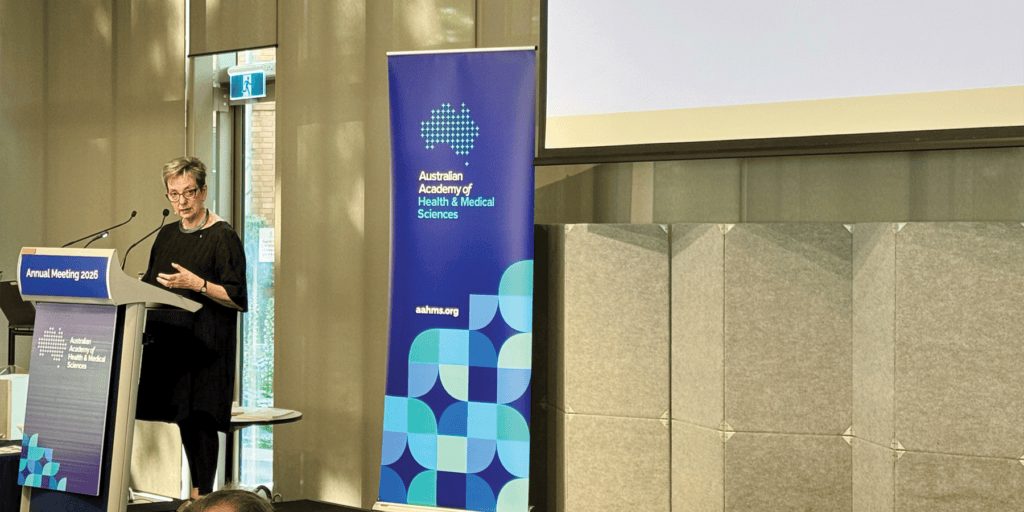
AAHMS President, Professor Louise Baur AM PresAHMS, said, “We tend to think of misinformation as a technology problem or an education problem. This report shows that there is also an important health component to it.”
“When we invest in supporting good health and preventing ill health, we are not only reducing the burden of chronic disease – we are building the cognitive and emotional foundations that help people think critically about the information they encounter every day.”
Trust is a whole-of-health function
A key insight from the report is that an individual’s capacity to evaluate information and decide who to trust is not governed by any single part of the brain. It is a complex process involving multiple brain regions and neural pathways, shaped by a person’s emotional state, individual experiences, cognitive function, and overall health – as well as by the situational context at hand.
This means that conditions affecting mental health – such as anxiety, depression, and loneliness – can impact on a person’s capacity to critically assess information. Factors that support good mental and physical health – including cardiovascular fitness, nutrition, social connection and sleep – can have a positive effect on this capacity.
Professor Baur added, “Trust emerges from an interplay of cognitive, emotional, and physiological processes. When any part of that system is under strain, a person’s ability to distinguish reliable information from unreliable information can be diminished.”
Building on AAHMS’ commitment to trust
The report sits within a broader program of work by AAHMS on strengthening public trust in health and medical science – one of the Academy’s three strategic policy priorities. Recent activities include:
- Devoting the Academy’s 2025 Annual Meeting to the theme of trust in health and medicine, convening experts from neuroscience, public health, Indigenous health, and science communication.
- Publishing “Understanding Trust in the Health and Medical Sciences”, a policy explainer examining the current state of public trust and the factors that shape it.
- Publishing an Evidence Brief on autism that directly addressed the spread of health misinformation, reaffirming what the scientific evidence makes clear in relation to autism.
“Understanding the relationship between health and trust is central to our work as an Academy,” Professor Baur said. “This report for the NSTC deepens that understanding by showing that the biological and psychological factors shaping how people engage with information are inseparable from their overall health. It reinforces why health must be part of any serious national conversation about information resilience.”
NSTC series on information resilience
The report is one of four prepared for the NSTC as a series of reports examining how resilience to misinformation can be strengthened in Australia.
The reports explore why people are susceptible to misinformation and how to build resilience at individual, community and societal levels. They found that misinformation poses a risk to Australia’s social cohesion, democratic resilience and decision making.
The reports are available from the Office of the Chief Scientist.
For media enquiries, please contact Khaled Chakli: 0448 754 065
AAHMS
Related Publications
Academy sets out priorities for strengthening trust in health and medical expertise