Wednesday, 29 October 2025
President’s opening address: 2025 AAHMS Annual Meeting
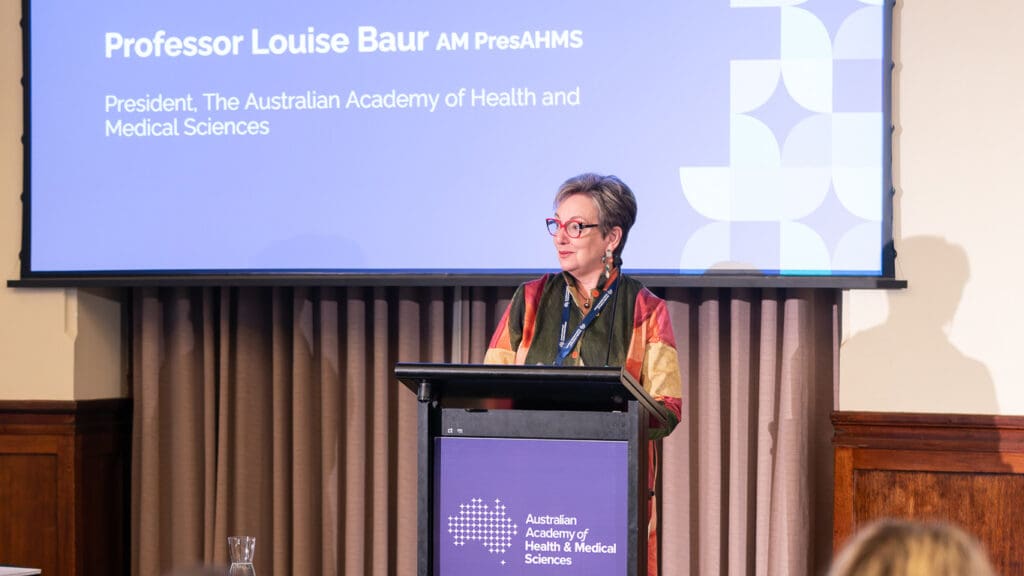
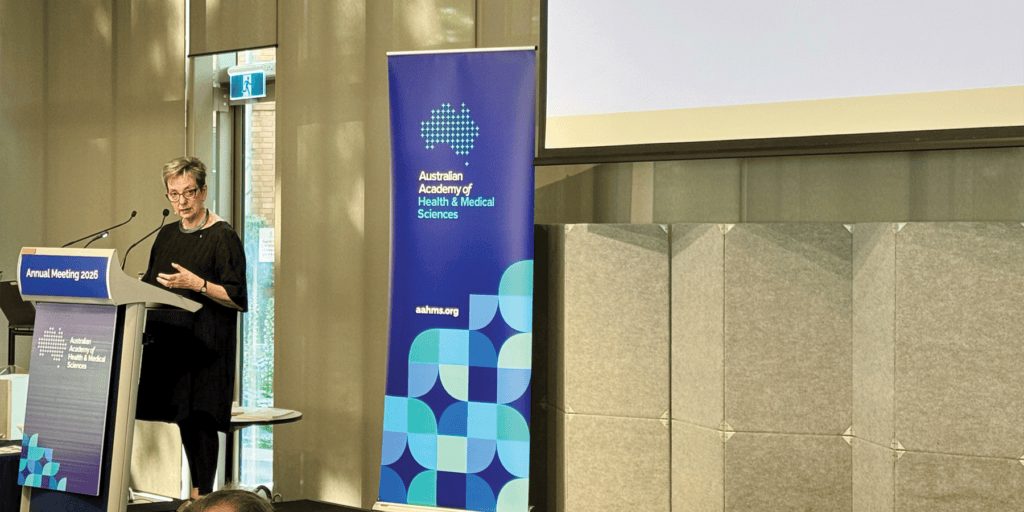
Good morning, everyone – Fellows, and guests – welcome.
I’d like to begin by acknowledging the Traditional Custodians of the lands on which we are gathered, lands which have never been ceded, lands of the Ngunnawal and Ngambri peoples, and to pay my respects to their Elders past and present. I also extend that respect to any Aboriginal and Torres Strait Islander people joining us today.
It’s a privilege to welcome you all to Canberra for the 2025 Annual Scientific Meeting of the Australian Academy of Health and Medical Sciences, and to extend a very special welcome to our soon to be inducted, new Fellows.
Each of you has been recognised by your peers for your outstanding contributions to health and medical science; contributions that have improved lives, shaped systems, and advanced knowledge here in Australia and across the world. Your election reflects not only excellence, but in generating world class outcomes, deepening understanding and generating impact. On behalf of the Academy, warmest congratulations.
The Academy itself was founded with a clear purpose: to bring together Australia’s most exceptional health and medical researchers to serve the public good.
We do exist not as a distant institution, but as a bridge, between science and society, between research and policy, and between evidence and care.
We do this through three core functions:
- providing independent, expert advice to government and decision-makers
- nurturing the next generation of leaders in health and medical science, and
- advancing health and medical research and its translation into benefits for all Australians.
We are the nation’s trusted advisor on matters of health and research – impartial, authoritative, and cross-sector. And we take that responsibility seriously.
This year, as we gather to celebrate the achievements of our newest Fellows, we also turn our attention to one of the most important issues of our time:
Trust in Health and Medicine.
Our program over the next two days brings together an extraordinary line-up of speakers and panellists – leaders from research, policy, healthcare, and industry, each bringing their own perspective on what trust means, how it is built, and how it is sustained.
Trust is not an abstract idea.
It is the quiet force that allows science to become policy, and evidence to become care. It underpins everything we do, from research integrity and communication, to clinical practice and health decision-making.
Trust in the health and medical sciences has long been a priority of our Academy. Our recent Academy analysis on Trust in Health and Medical Science found that, while Australians generally continue to express high levels of trust in doctors and scientists, that trust is uneven and increasingly fragile.
For the first time since 2016, vaccination rates for children at age two, have dropped below 90%.
Almost two-thirds of Australians say they worry about medical science becoming politicised.
And among young people globally, nearly half report having made a health decision they later regretted because of misinformation.
These trends matter.
They matter because trust is what makes an evidence-based system work. It is the invisible infrastructure that sustains public health.
And in a country where the delivery of universal, evidence-based healthcare is a core component of the social contract, health itself is a national institution.
It binds us, as a society, together.
Across geography, culture, and background, through a shared expectation that care will be guided by science, delivered with compassion, and accessible to all.
But when trust in the health and medical sciences, the very foundation of that evidence-based-care, begins to weaken, the consequences can extend far beyond health.
Social cohesion begins to fracture when trust is eroded. In that event, the very institutions our democracy depends on, can become weakened.
That is why trust in health and medicine must be seen as a national priority.
Because when people lose faith in the evidence that underpins care, they begin to lose faith in the systems that serve them, and that loss of faith reverberates through society.
Our analysis shows that trust is relational.
It flows between people and institutions, between patients and clinicians, between researchers and policymakers, between governments and communities.
When those relationships work, they create reinforcing cycles of confidence and collaboration.
When they break down, trust is hard to rebuild.
Rebuilding it requires transparency, competence, fairness, and, above all, listening.
It also requires us to adapt to a new reality, that trust today is no longer top-down.
It is built from the ground up. In doctors’ rooms, local services, families, and increasingly, in online spaces that shape how people seek information and make health decisions.
If we are to strengthen trust in science, we must meet people where they are. And we must do so with honesty, empathy, and respect.
So, as we begin this year’s meeting, I invite each of us to think about what it means to earn trust, not assume it.
How can our research, our communication, and our leadership reinforce the confidence of those we serve?
How do we ensure that science remains a source of clarity in an age of uncertainty and that evidence remains stronger than misinformation?
Over the next two days, these questions will guide our discussions, across disciplines, across institutions, and across generations.
Together, we can maintain and strengthen the Academy’s role as a trusted advisor to government, to the health sector, and by extension, to the Australian people, and in doing so, strengthen the foundations not just of our health system, but of our democracy itself.
To that end, let us lead with integrity, listen with empathy, and act with purpose.
Thank you, and welcome, to the 2025 Annual Scientific Meeting of the Australian Academy of Health and Medical Sciences.
– Academy President Professor Louise Baur AM PresAHMS –
AAHMS
Related Publications
Academy sets out priorities for strengthening trust in health and medical expertise